
What Is Seal Script? The 2,000-Year Lineage Behind Your Hanko
In a separate piece we took an honest look at the "good fortune" sold with Japanese seals — the lucky stroke counts, the eight directions, the unlucky names you can pay to fix — and found that most of those promises are surprisingly modern marketing, not ancient wisdom.
That leaves a fair question: if the fortune is a recent story, is anything about a Japanese seal actually old?
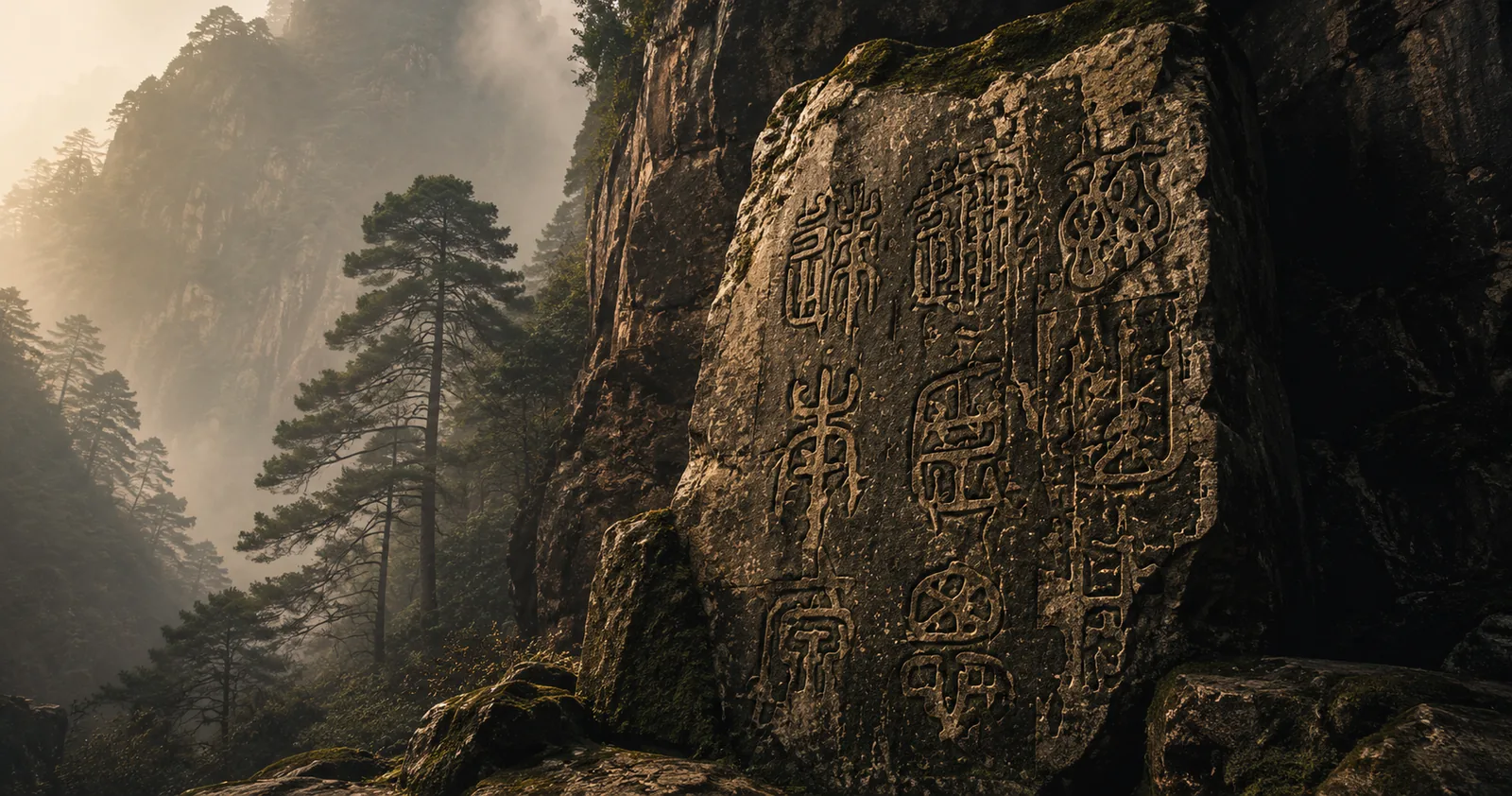
Yes. One thing, and it's the most important thing — the writing itself. The dense, looping characters on a hanko aren't a decorative font someone invented to look antique. They're seal script (tensho, 篆書), and they belong to one of the longest-running writing traditions on earth. Here is where it actually comes from.
221 BC: a script to bind an empire
For centuries before unification, the warring states of China each wrote the same words in noticeably different shapes — close enough to puzzle out, far enough apart to slow an administration down. When the state of Qin conquered the rest and the First Emperor took the throne in 221 BC, he treated this as a problem of government, not calligraphy.
Alongside standardizing the currency, the roads, and the weights and measures, he ordered the writing standardized too. The work fell to his chancellor, Li Si, who took the older, heavier "great seal" forms and pared them into a single clean, balanced standard now called small seal script (shōten, 小篆). Outlawing the old regional characters and spreading one script was, in its way, the operating system of the new empire — the same Li Si who set up the centralized province system that would shape Chinese governance for the next two thousand years.
So when people say the script on a seal is "ancient," this is what they mean, and for once it's literally true: the lineage runs back more than 2,200 years to the founding act of the first unified Chinese state.
The script that outlived its own job
Here's the twist that makes seal script special. As an everyday writing system, it barely lasted a generation. Those graceful curves were slow to brush, and the clerks of a busy law-driven state quickly rounded them off into something faster. Within decades the official script had moved on — to clerical script, then eventually to the regular script that East Asia still writes today.
But seal script never disappeared. It survived by retreating to the one place that valued exactly what made it impractical: its weight, its formality, and its difficulty to copy. It survived on seals. That's why, of all the historical Chinese scripts, seal script is the longest-lived in continuous use — not because people kept writing letters in it, but because for two millennia it remained the script of authority, the mark you pressed to say this is real, and it is mine. Japan inherited that convention and still keeps it: official and registered seals are carved in seal script to this day.
印篆 — bending the script to fit the stone
A seal face is a small square. Small seal script is tall and rounded. Fitting one into the other took its own craft, and that craft produced a specialized form: inten (印篆), seal-script-for-seals, settled into the shape we recognize from the Han dynasty onward.
To pack a vertical, curving character into a square without wasted space, carvers turned curves into straight strokes and folds, squared the proportions, and let the lines fill the face evenly. The result is denser, more architectural, and more interlocked than ordinary seal script — characters built to occupy a field rather than sit in a line. This is the deep ancestor of seal composition: the discipline of balancing ink and empty space across the whole face. It's the same problem, two thousand years later, that decides whether a modern seal looks composed or just stamped.
Kissō-tai — the modern Japanese descendant
Now we can place the style you'll see marketed most often in Japan today: kissō-tai (吉相体), also called insō-tai (印相体). It's the swirling script whose strokes reach out to every edge and touch the frame, sold for personal seals and "good-fortune" seals.
Honesty matters here, and it's the same honesty as our fortune piece: kissō-tai is not ancient. It's a modern style, worked out in Japan around the 1970s, built on the older seal-script and inten forms but shaped for the personal-seal market. Anyone telling you this specific style is a thousand years old is selling the romance, not the history.
What's true about it is better than the romance anyway. Two of its qualities are simply real:
- It's hard to forge. The dense, interlocking strokes make a kissō-tai impression genuinely difficult to copy by hand or by eye — which is exactly why it's favored for seals that need to be hard to fake. Each composition ends up one of a kind.
- It's physically durable. Because the strokes reach out and meet the frame at many points, the carved seal is less prone to chipping at the rim — the place hand seals usually fail first.
The famous "eight directions" reading layered on top — strokes leaning toward fortune, love, enterprise, and so on — is best treated the way we treat it throughout SealFont: by tradition, not as a prediction. A lovely way to read a seal, not a forecast to bank on.
Where SealFont fits
Lay it out as a line and the shape is clear:
Seal script (Qin, 221 BC, Li Si — two thousand years) → inten, bent to fit the seal face → kissō-tai, the modern Japanese personal-seal style → SealFont, the same tradition rendered, for the first time, in the Latin alphabet.
That's the whole point of what we make. SealFont doesn't drop your name into a circle and call it Japanese. It composes your Latin letters in the spirit of seal script — built to fill the face, reach the frame, and read first as a seal and second as your name. The newest link in a very old chain.
The honest takeaway
The "luck" sold with a Japanese seal is mostly a modern invention. But the script is the real inheritance — more than two thousand years of writing meant to carry authority and identity, kept alive on the one object that still needed it.
A seal can't promise you fortune. What it can carry is something rarer and entirely true: a name, set down in a script that has meant this is real, and it is mine for two thousand years.
The newest link in a very old chain
Turn your name into a personal signet, composed in the spirit of seal script — built to fill the face and read first as a seal, second as your name. One of one, high-resolution, with a full commercial license.
Create yours →Want the practical side instead? Start with What Is a Hanko? for the seals you'll actually meet in Japan — and whether you can register one in your own romaji name. Or browse the Journal.
A note on sources: the seal-script history here draws on standard references for the Qin unification of writing and Li Si's small seal script, the development of inten for seal use, and seal-industry accounts of kissō-tai / insō-tai as a modern personal-seal style.