
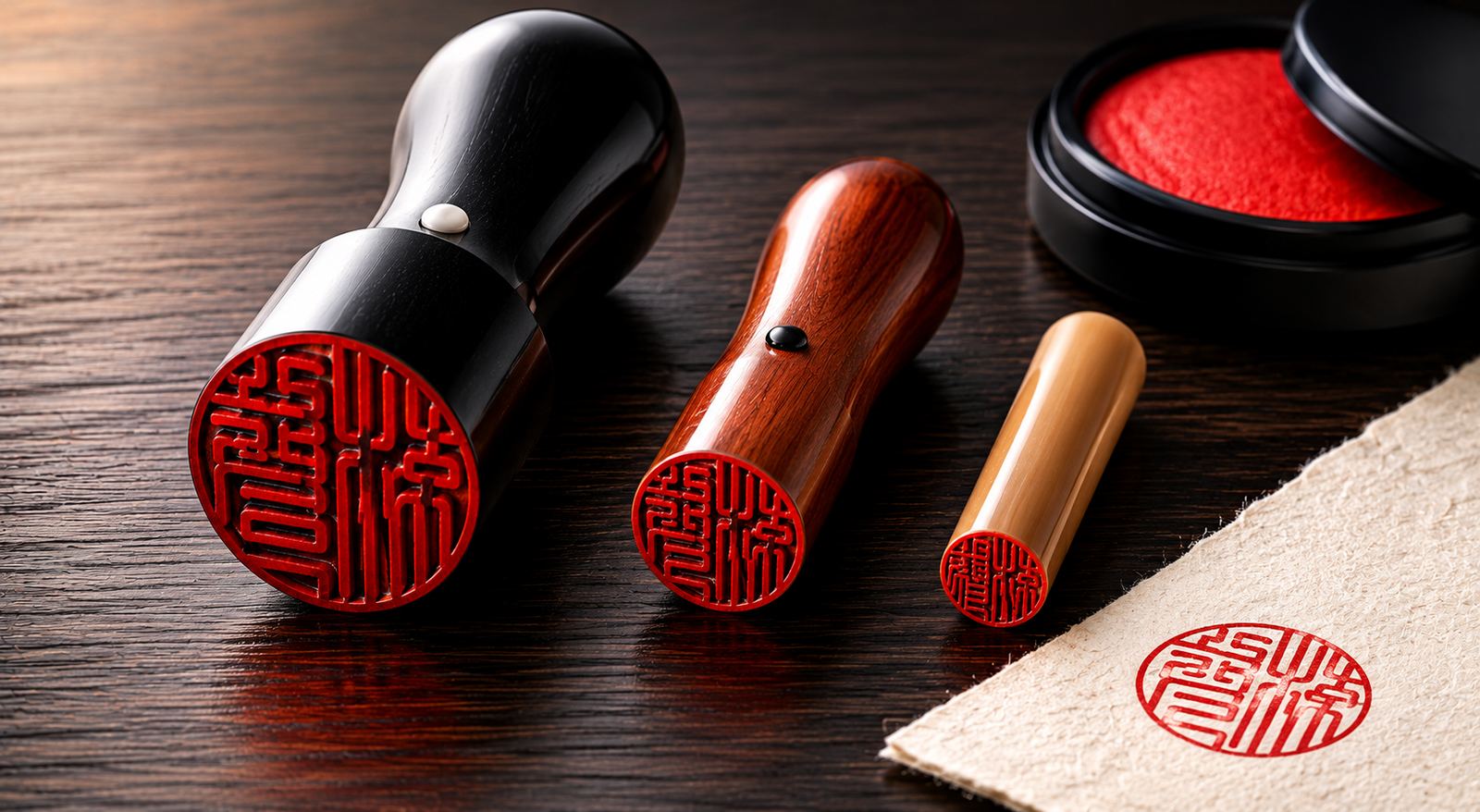
Can Foreigners Register a Hanko in Japan? Romaji Seals Explained
Sooner or later, almost every foreign resident in Japan runs into the question — usually while buying a car, signing a lease, or handling something at the bank that a casual stamp won't cover. Someone asks for your jitsuin, your registered seal, and you realize you don't have one. Can you even get one as a foreigner? And does it have to be in katakana?
Here's the straight answer, and the details that actually decide it.
The short answer
Yes — in most cases, foreign residents can register a personal seal (実印) and receive the certificate that gives it legal force. And the rules have loosened: many municipalities now accept seals in the Latin alphabet (romaji), not just katakana, as long as the name matches your resident record.
The phrase doing the heavy lifting there is "most cases." Whether your seal is accepted comes down to your city and to exactly how your name is recorded — so let's break that down.
You're already in the system
Since 2012, foreign residents have appeared on the resident record (住民票, jūminhyō), the same register used for Japanese citizens. That record is the anchor: your seal has to correspond to the name printed on it. Your jūminhyō generally shows your name in the Latin alphabet, and it can also carry a registered common name (通称) in kanji or katakana if you've chosen to add one.
Romaji or katakana?
For years, the standard advice was to get your name carved in katakana. It worked — but it always felt like a phonetic costume. Maikeru instead of Michael.
Now a growing number of municipalities accept romaji seals for registration, as long as the alphabetic name matches your jūminhyō. That means you can register a seal showing your actual name, in your actual letters. (If your city still insists on katakana, you can register a 通称 in katakana and base the seal on that — but the romaji route increasingly removes the need.)
The honest caveat: acceptance varies by municipality. Some accept full romaji freely; some want it to match a specific field on your record; a few remain conservative. The only authoritative answer is your local ward or city office.
What makes a seal registrable
Whatever the script, a seal usually has to clear a few bars to be accepted as a jitsuin:
- It shows your name as recorded — full name, family name, or given name (which combinations are allowed varies locally).
- It's legible and within the size limits — the impression typically has to fit within roughly an 8mm–25mm square, with exact limits set by each office.
- It's reasonably unique — many offices reject cheap, mass-produced ready-made stamps for a jitsuin, since a registered seal is meant to be hard to duplicate.
- One per person, one per household slot — you can't register a seal already registered to someone else in your household.
This is exactly why traditional seals are carved in dense, woven seal script (篆書): legible enough to read, hard enough to forge. That combination is the whole point of a registered seal.
How to register, step by step
- Get or make your seal, meeting your city's size and format rules.
- Go to your local municipal office — the one for your registered address — with the seal and your residence card (在留カード).
- Apply for seal registration (印鑑登録). You'll usually receive a seal registration card (印鑑登録証).
- Request the certificate (印鑑登録証明書) whenever a transaction needs proof. The seal plus the certificate is what makes a document legally binding.
After that, your jitsuin does everything a Japanese resident's does: property, vehicles, major contracts.
One thing to check before you carve
Because the rules genuinely vary, the smart move is a quick check before you commit to a design. Ask your local office — or look at its website — whether it accepts alphabet / romaji seals, and what its size limits are. Two minutes there can save you a re-carve later.
Your name, ready in real seal script
SealFont composes your actual Latin name in authentic seal script — delivered as high-resolution PNG with a full commercial license. Use it for digital signatures, documents, and branding straight away; and if you decide to register a physical seal, it's the design to take to an engraver. Registration itself is always your municipality's decision, so confirm their rules first — but your name, rendered as a genuine seal rather than a font dropped in a circle, is where it starts.
Create yours →New to all this? Start with What Is a Hanko? A Foreigner's Complete Guide.