
Jitsuin vs Bank Seal vs Mitome-in: Japan's Three Seals, Explained for Foreigners
Japan does not have "a hanko." It has a ranking system of seals, and the rank decides everything: what the seal can legally do, what rules apply to its design, and how strictly a counter clerk will squint at it.
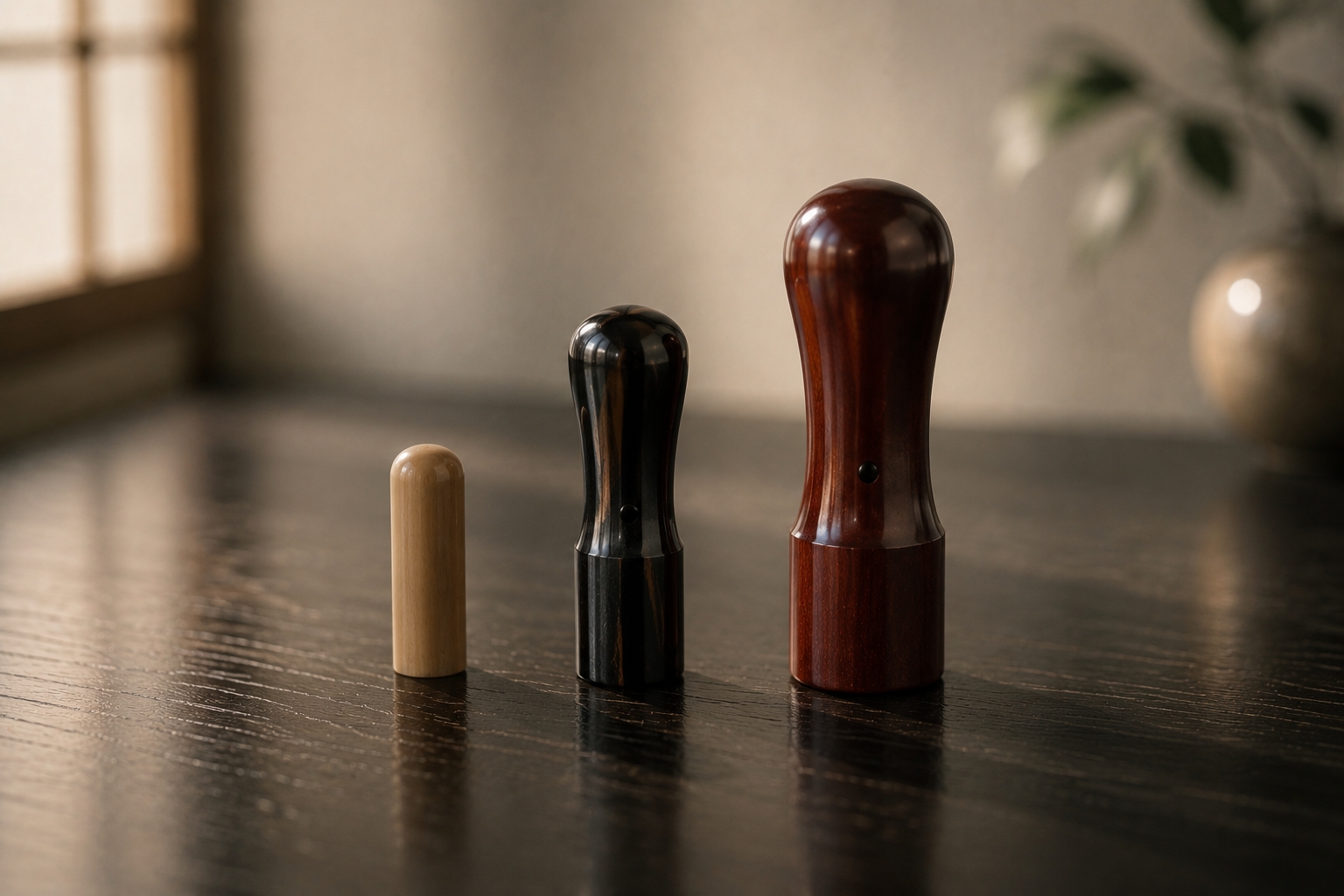
Most guides explain the three ranks in two lines and move on. This one goes further, because we did the homework: we read the actual seal-registration ordinances of cities including Yokohama, Osaka, Kyoto, Chiba, Gifu, Hamamatsu and others — and we compared the written rules with what actually happens at the counter. The two are not the same, and the gap is exactly where foreign residents get surprised.
The one-minute map
Mitome-in (認印) — the everyday seal. Package deliveries, internal office forms. No registration, almost no rules. Anything goes, including the ¥100-shop seal.
Ginkō-in (銀行印) — the seal you register with your bank. From that day on, its physical impression is what authorizes money to move at the counter.
Jitsuin (実印) — the seal you register at city hall. Paired with the official seal certificate the city issues, it is the strongest form of personal authorization in Japan: property purchases, car contracts, loans, incorporation, inheritance.
The higher the rank, the more the seal's design is regulated — and the more it matters whose name is on it.
Jitsuin: the written rules
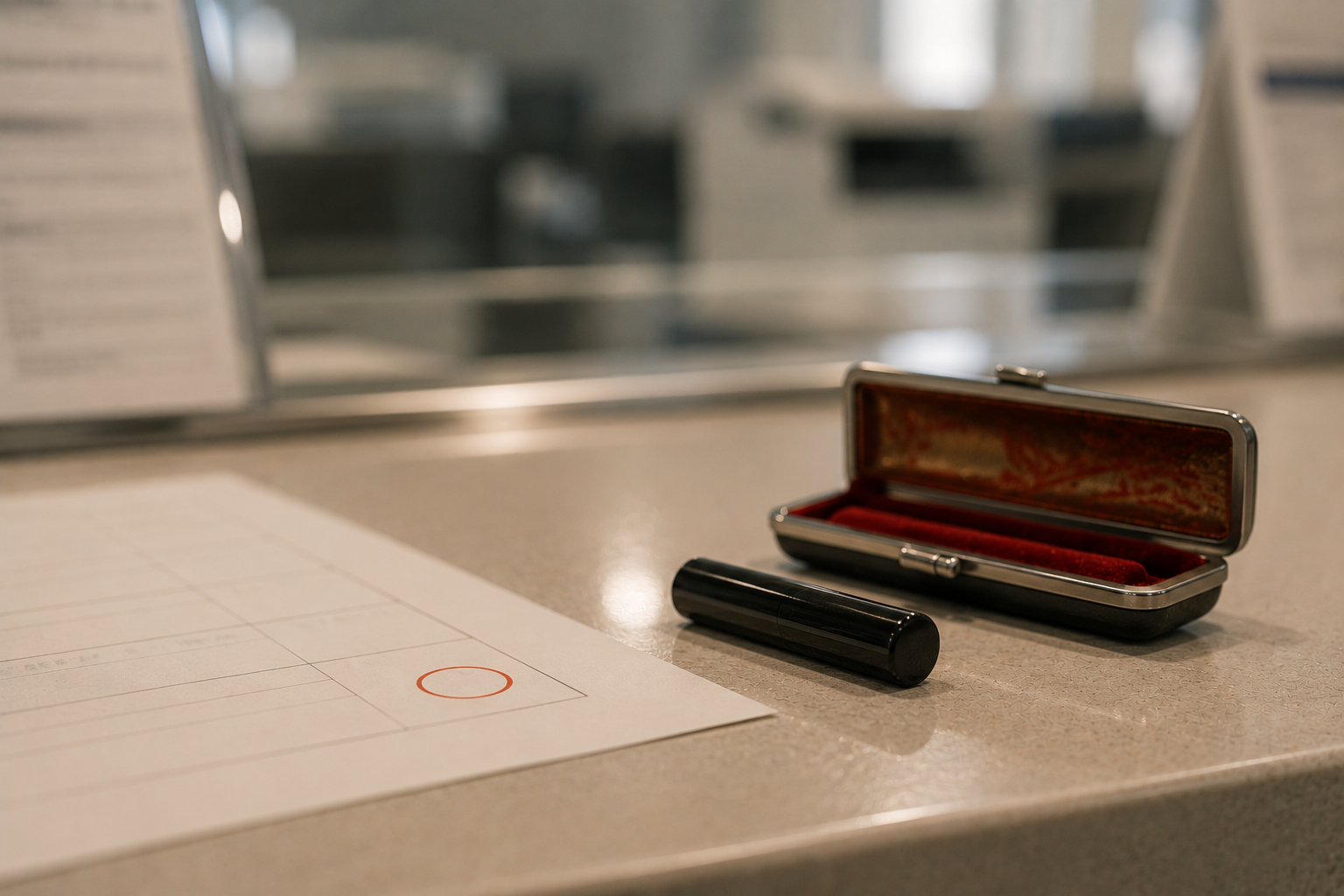
Municipal ordinances vary in wording, but reading across cities, the common core is remarkably consistent:
- The seal must represent the name exactly as it appears on your resident record — nothing more, nothing less. Titles, decorations, or extra words disqualify it.
- Size window: the impression must fit between roughly 8mm and 25mm square.
- No easily deformable materials (rubber stamps are out), and the impression must be sharp and stable.
- Mass-produced seals — the kind where identical impressions are sold nationwide — are refusable in several cities' rules. A registered seal is supposed to exist once.
- Initials alone, or mixing scripts inconsistently with your registered name, can be refused (Hamamatsu's rules are explicit on this).
Now, three findings from the ordinances that matter specifically to foreign residents:
First — the Latin alphabet is not a workaround. It is the default. A foreign resident's record carries the name as printed on the residence card, which for most non-kanji-country nationals means the Latin alphabet. Since the seal must match the resident record, a seal in your own alphabet is the most natural fit the system allows. Ironically, katakana is the complicated option: several cities (Yokohama, Osaka, Chiba among them) require a katakana rendering to be registered in advance as an official annotation on your record before a katakana seal can be accepted.
Second — there is a stylization clause. Hamamatsu's rules, for example, refuse seals "so extremely stylized that they no longer represent the person's name by social convention," and several cities have legibility clauses. Read literally, this sounds like it would ban the traditional kissō-tai and insō-tai styles — which are famously hard to read. In practice it does not: hard-to-read auspicious scripts have been the standard choice for jitsuin for decades. The clause exists to stop seals that have stopped being a name at all. This is a real example of the theme of this article: the written rule and the counter practice are different things, and the counter has its own long-standing customs.
Third — some designs are banned by name. White-on-red (hakubun) impressions are explicitly non-registrable in Osaka's handling rules, because reversed impressions are hard to verify. And both Yokohama and Osaka explicitly refuse seals where the name is worked into an animal silhouette or pictorial design. If you ever see a beautiful seal where a name hides inside a dragon — that is art, and art it must remain. It cannot be your jitsuin.
The bank seal: looser on paper, stricter at the counter
Here is the counterintuitive part, and it comes from lived experience as much as from rules.
On paper, bank seals are barely regulated. Banks generally accept alphabet, katakana, kanji, even seals that would fail jitsuin registration. You will read everywhere that "the bank seal rules are relaxed."
At the counter, the opposite is often true. The bank seal is the one object that moves your money, and banks run their own defensive practice on top of the loose rules:
- Tellers want a seal that is recognizably your name — heavy stylization invites questions.
- Some banks are wary of machine-cut or data-engraved seals with very fine lines, because fine lines chip and smudge with use, and a degraded impression fails verification — which becomes the bank's problem.
So the honest ranking of strictness is not what the rulebooks suggest. Written rules: jitsuin strict, bank loose. Lived practice: the bank counter can be the fussier of the two.
How banks actually verify your seal
Understanding the mechanism explains the fussiness.
Until the early 2000s, Japanese passbooks carried a printed copy of your registered impression inside the cover — the fuku-inkan (sub-seal). Then a wave of fraud hit: thieves who stole a passbook could see the impression, have a copy carved, and withdraw money. Banks responded by abolishing the sub-seal and moving registered impressions into electronic image databases.
Here is the part most people don't know: the database did not automate the judgment. When you stamp a withdrawal slip today, the teller pulls your registered impression up on a monitor and compares the two red impressions by eye. Modern verification systems help — they auto-align, overlay, and magnify the images — but the final call is still a trained human looking at two seals for a few seconds. Japanese court precedent has blessed exactly this: side-by-side naked-eye comparison by a clerk exercising reasonable professional care is the accepted standard, no magnifying glass required. The precedent even accepts the limit that follows — if a forged impression is so close that a careful, trained eye cannot tell the difference, the bank is not at fault for honoring it.
Once you see this, the bank counter's unwritten preferences stop being arbitrary and start being obvious:
- Fine lines that chip are a real problem. The whole system rests on a stable, sharp impression. A hairline that wears down or clogs with paste produces a mismatch at the only checkpoint that exists — a human eye, in seconds.
- "Recognizably a name" matters because the teller is not running forensics; they are pattern-matching under time pressure.
- And it quietly explains the deepest truth about seals: eye-level verification cannot catch a sufficiently good look-alike. The law itself concedes this. A seal's real security has never been that forgery is impossible — it is that your particular impression exists exactly once, somewhere it can be compared against. Which is why an impression thousands of strangers can buy at a ¥100 shop fails the entire premise.
Mitome-in: the free zone
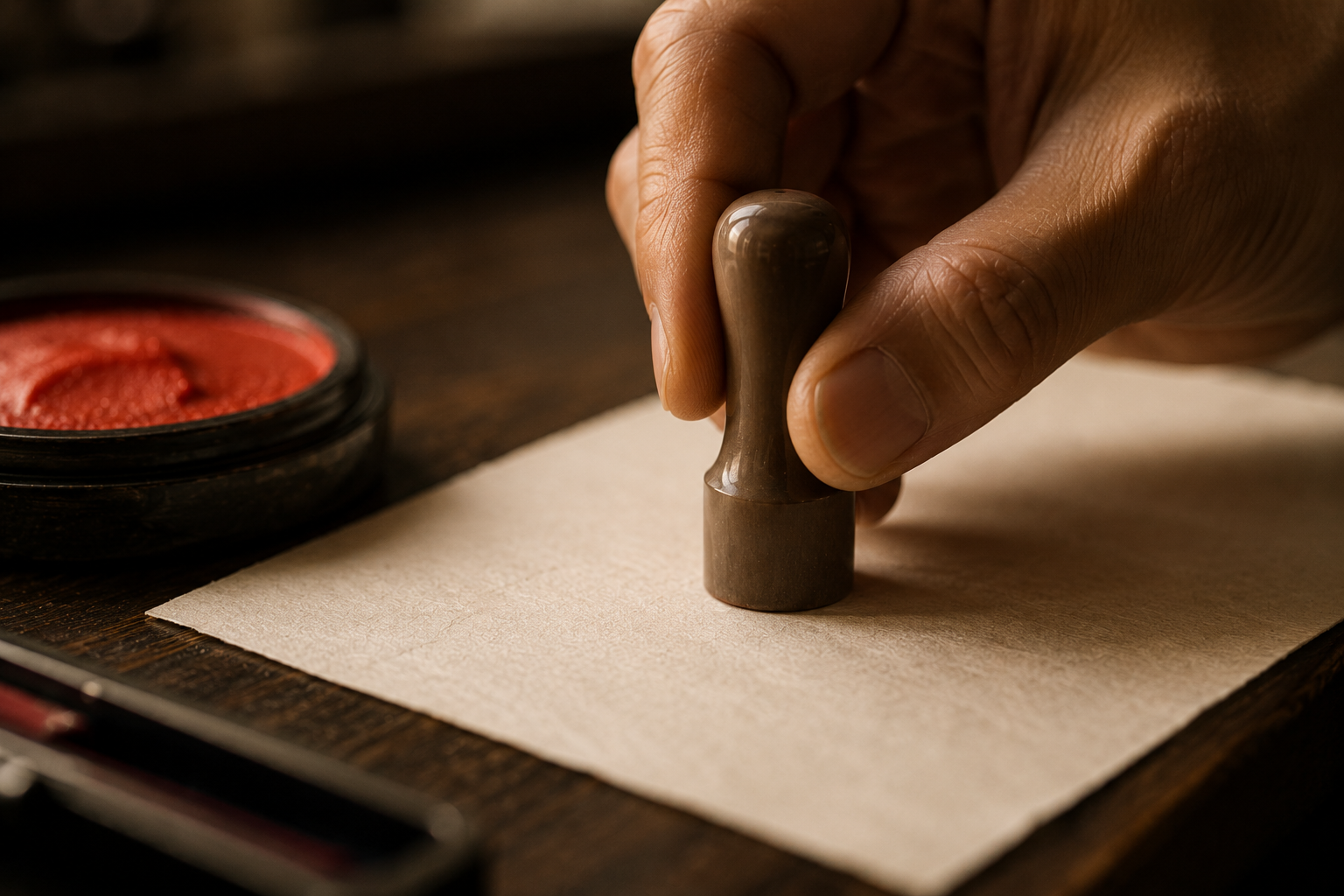
Anything goes. This is where the ¥100 seal, the novelty seal, and the souvenir seal live happily. The only real advice: never promote a mass-produced seal to registered duty. An impression that thousands of strangers can buy for pocket change should not be the key to your money or your legal identity.
What this means if your name is in the Latin alphabet
Put the three sections together and a clear picture emerges for foreign residents:
- Your alphabet is your strength, not your obstacle. It matches your resident record, which is the single most important registration requirement.
- Style has a window. The tradition itself proves that "hard to read at first glance" is acceptable — kissō-tai has been registered for decades. The line is "no longer a name at all." A seal whose letters can be traced on a second look sits inside the window.
- Expect the counter, not the rulebook. For a jitsuin, call your city hall first. For a bank seal, ask your branch — and expect them to care more about durability and recognizability than any written rule would suggest.
For what one resident's experience is worth: I have registered Latin-alphabet seals in Japan as both a jitsuin and a bank seal, and have never been refused. One person's record is not a guarantee — municipalities and banks decide case by case — but it is proof that the door is open.
Where SealFont honestly fits
SealFont composes your name — the Latin alphabet, in the manner of kissō-tai — as a one-of-one seal impression, free to create. The paid tier includes engraving vectors (AI/EPS/SVG); two Japanese hanko workshops have confirmed they accept our files, so the data can be used to manufacture a real physical seal. Whether that carved seal can then be registered as your jitsuin or bank seal is decided by your municipality or bank, not by us — and given everything above, the honest advice is the same we follow ourselves: carve it well, keep the name traceable, and ask the counter first.
One more thing, in the spirit of this article. We will not pretend to be exempt from the eye-level limit described above: two people with the same name will receive seals that look similar — same letters, same compositional grammar. That is precisely why every seal we compose is fingerprinted at the coordinate level and recorded once, under a serial number, in our registry. To the eye, similar; in the mathematics, provably distinct — and provably yours. A seal's uniqueness should not depend on how hard a teller squints, so we anchored it somewhere a squint can't reach.
Quick answers
Which seal do I actually need first? Usually none, then a bank seal if your bank asks, then a jitsuin only when a big life event (property, car, company) demands it.
Can all three be the same seal? Physically possible, strongly discouraged. If one seal is lost or compromised, everything is. Rank your seals like the system does.
Can my jitsuin be in the Latin alphabet? In many municipalities, yes — it matches your resident record. Katakana often requires prior annotation. Ask your city hall.
Why was my beautiful stylized seal questioned at the bank but fine at city hall? Because the bank counter runs on practice, not ordinance. See above.
SealFont composes Latin-alphabet names in the manner of kissō-tai, the auspicious Japanese seal script. Free, no login: sealfont.com
See your name as a real seal
Type your name and watch it composed in the manner of kissō-tai — one of one, free to create and free to use, no login, with the engraving data ready when you want it carved.
Create yours →Keep reading: Can Foreigners Register a Hanko? for the step-by-step registration process, or What Is a Hanko? for the seals themselves and how red and white impressions differ. Or browse the Journal.