
Why Does the West Sign, and Japan Seal?
A contract slides across the table. In London or New York, you uncap a pen and write your name in your own hand. In Tokyo, you take a small carved cylinder from its case, press it into red paste, line it up over a printed circle, and stamp. Two cultures, the same moment — yes, I agree, this is me — and two completely different objects doing the work.
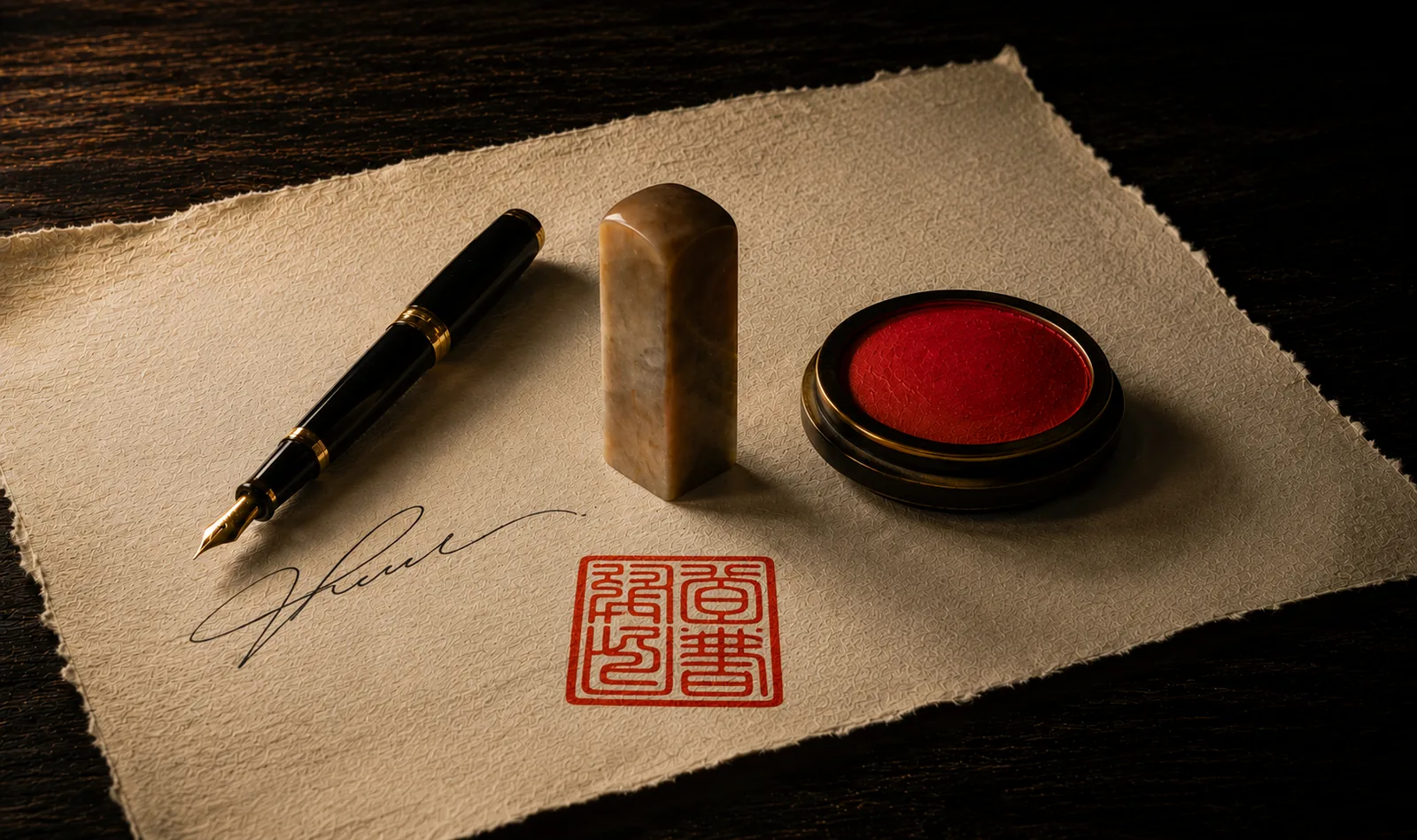
It's easy to assume one is just the local flavor of the other. They're not. The signature and the seal rest on opposite theories of how trust works. That difference is the interesting part.
How the seal got to Japan in the first place
Worth saying plainly: the seal isn't originally Japanese. Like the writing system and Buddhism, it came from the Asian mainland. The oldest seal known in Japan is a solid gold stamp said to have been given by the Han Chinese emperor to a local ruler in northern Kyushu in 57 AD — and for centuries afterward, seals were the exclusive privilege of emperors and top officials, a symbol of imperial authority rather than personal identity. Only much later did the seal travel down through the aristocracy, the samurai, and finally — with a national registration law in the Meiji era — into the hands of ordinary people. (For that whole arc, see What Is a Hanko?)
The West, meanwhile, had wax seals too, but let the handwritten signature win out as the everyday mark of a person. Two roads, two defaults.
The real difference: two theories of trust
Strip away the history and you find the genuinely fascinating contrast. A signature and a seal are secured by opposite logics.
A signature's security lives in uniqueness. The premise is that no two hands write quite alike, that your scrawl is hard to reproduce, that an expert could tell a forgery from the real thing. It is a system built in anticipation of fraud — designed, from the start, to be checked, doubted, and defended against.
A seal works the other way around. Its premise is trust. Pressing your hanko is treated as a deliberate, responsible act, and the system assumes you are the one pressing it. Using another person's seal without permission isn't a clever trick to guard against — it's an unthinkable breach, identity theft with heavy social and legal consequences. The seal's safety rests less on the object being impossible to copy than on a society that collectively agrees the gesture is sacred. One system anticipates the worst of people; the other presumes the best.
The honest caveat
That trust-based design has a soft spot, and it's only fair to name it. An everyday personal seal — a mitomein — is often mass-produced; someone with a common surname can buy a near-identical stamp at a hundred-yen shop. On its own, it isn't hard to fake at all.
What makes a seal genuinely secure is the other end of the spectrum: a custom-carved registered seal, the jitsuin, backed by a government certificate. That pairing is effectively two-factor — the physical seal you possess plus the official record that says it's yours. The security was never really in the stamp alone. It's in the stamp, the registry, and the social contract that takes all of it seriously.
Why the gesture feels heavier
There's one more thing a pen can't quite match. A signature can be dashed off — messy, fast, half-attended. A seal asks for a small ceremony: open the case, ink the face evenly, check that the characters sit upright, align it inside the circle, press with steady pressure. Many people in Japan say a contract feels more real when stamped than when signed — the deliberate act turns an abstract agreement into a physical deed. The weight isn't legal. It's psychological, and it's the point.
Where SealFont fits
A SealFont signet lives at the meaningful end of all this. It isn't a hundred-yen lookalike — it's a one-of-one mark composed for your name alone, the kind of seal whose whole value is that no one else has it. And for a foreign resident, choosing a personal seal is a small way of stepping into that culture of deliberate commitment: a mark you press on purpose, that says I mean this, in a tradition that has always treated the gesture as something to be trusted rather than doubted.
You can sign your name anywhere. A seal asks you to mean it.
A mark you press on purpose
Turn your name into a personal signet, composed in the seal-script tradition and delivered as a red mark you can press onto whatever you make. One of one, high-resolution, with a full commercial license.
Create yours →Foreign resident wondering about the legal side? Read Can Foreigners Register a Hanko in Japan? — or browse the Journal.