
What Is a Rakkan? The Red Seals on Japanese Art, Explained
Stand in front of a piece of Japanese calligraphy or an ink painting and your eye eventually lands on it: a small, vivid red seal pressed into a corner, glowing against the black ink and pale paper. Sometimes there are two. Sometimes three, scattered down the side like punctuation.
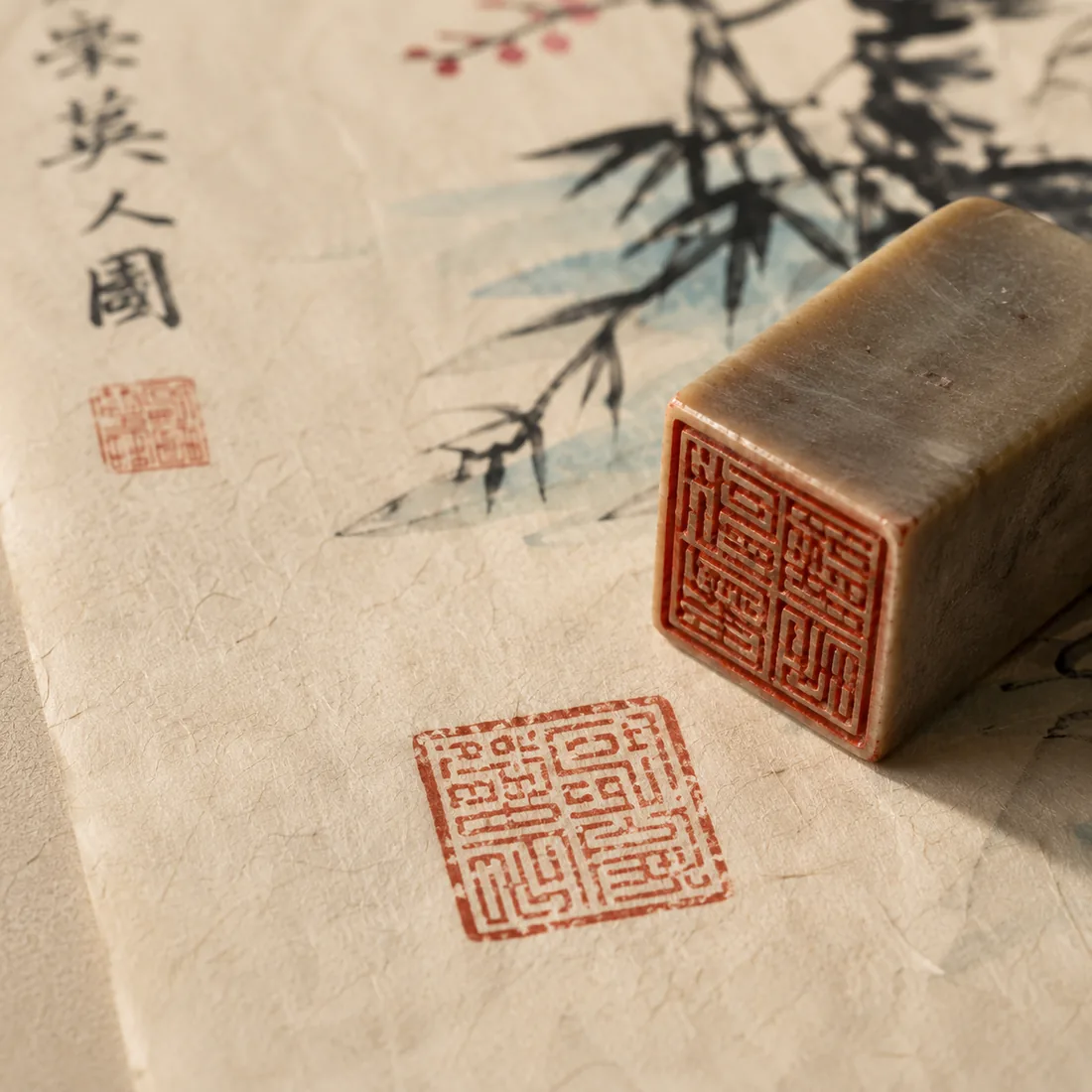
That seal is called a rakkan (落款), and it isn't decoration — it's a signature, a date, a blessing, and a mark of completion, all compressed into a few square centimeters of red. Once you know how to read it, you can't stop noticing it.
The word itself tells the story
Rakkan is short for rakusei-kanshi (落成款識). Rakusei means "completion" — the same word used when a building is finished. Kanshi refers to characters carved or inscribed into something. Put together, the term means the mark that says: this work is finished, and I made it.
Strictly speaking, a full rakkan is the whole act of signing off — the written signature, the date, sometimes the place and occasion, and the stamped seal at the end. In everyday use, though, people now mostly mean the red seal itself. The habit came to Japan with Chinese painting and calligraphy, and from the Edo period onward, Japanese artists and calligraphers adopted it to raise the standing of a work and to prove it was genuinely theirs.
The three seals — a quiet grammar
The most formal version uses three seals, together called the sankain (三顆印, "three-stone seals"). Each has its own job, its own shape, and its own color logic.
The name seal (姓名印, seimei-in). The artist's name — usually the given name, sometimes the full name. By tradition this is carved as hakubun: the characters cut away so they print white on a field of red. It carries the weight of authorship, the equivalent of a signature.
The art-name seal (雅号印, gagō-in). Many artists work under a gagō — an art name, a bit like a pen name, often granted by a teacher. This seal carries that name and, as a counterpart to the white name seal, is traditionally carved as shubun: the characters themselves print red. When both appear together, the white name seal sits above and the red art-name seal below.
The lead seal (引首印, inshu-in). Also called the kanbō-in, this one usually isn't a name at all. It's pressed at the upper right, where the work begins, and carries a phrase — a favorite line of poetry, an auspicious word, a motto. It's typically tall and narrow, and can be red or white. Its job is partly to "open" the piece and partly to balance the composition.
There's also a looser, freer cousin: the yū-in (遊印, "play seal"), pressed into an empty corner wherever the picture needs a little weight, carrying any phrase or even a pictorial mark the artist likes.
White seal, red seal — the same idea as a hanko
If you've read about Japanese seals before, this red-and-white distinction will sound familiar — it's the same shubun/hakubun logic that runs through all East Asian seals, defined not by what they say but by what's carved away. On a name seal, the characters are cut out and print white; on an art-name seal, the characters stand up and print red. Pairing the two — white above, red below — gives the corner of a painting a balanced, deliberate finish.
Reading the placement
Once you know the grammar, the corners of a scroll start to make sense:
The upper right tends to hold the lead seal — the opening note. The lower left, near the written signature, is where the name and art-name seals stack, white over red. Stray seals tucked into the lower right or open spaces are play seals, added for balance and pleasure. Size is judged against the brushwork, not the paper — a seal that overwhelms the strokes is as wrong as one that disappears.
And here's the honest, modern footnote: almost none of this is mandatory anymore. The full three-seal set is the formal ideal, but contemporary artists routinely drop the lead seal, or use a single seal alone — especially on small works like shikishi boards and poem cards. One well-placed red mark is often the whole story now.
More than a flourish
A rakkan does real work beyond looking beautiful. It marks completion. It names the maker. And because each artist's seal is a unique carving, it has long served as a tool for judging authenticity — a forger has to fake not just the brushwork but the precise character of the seal. The red mark is, in a quiet way, the most personal thing on the page.
That's also why the tradition feels worth carrying forward, even far from a calligrapher's desk. The impulse behind a rakkan — to close something you've made with a mark that is unmistakably yours — is older than signatures and bigger than any one art form.
At SealFont, that's the spirit we build on: your own name, composed in the seal-script tradition and rendered as a red mark you can press onto whatever you make. You don't need a gagō or a teacher's blessing to want one. You just need a name worth sealing.
Make a mark that's unmistakably yours
Turn your name into a personal signet, composed in the seal-script tradition and delivered as a red mark you can press onto whatever you make. One of one, high-resolution, with a full commercial license.
Create yours →New here? Start with What Is a Hanko? or browse the Journal.